

Project Objectives

The main goal and challenge of this proposal is the development of an innovative approach for the treatment of Multiple Sclerosis (MS)
The proposal comprises the design and synthesis of peptide analogues and/or petidomimetics based on immunodominant epitopes of myelin proteins, and their encapsulation in poly (lactic-co-glycolic) acid nanoparticles (PLGA NPs) conjugated with mannose components.
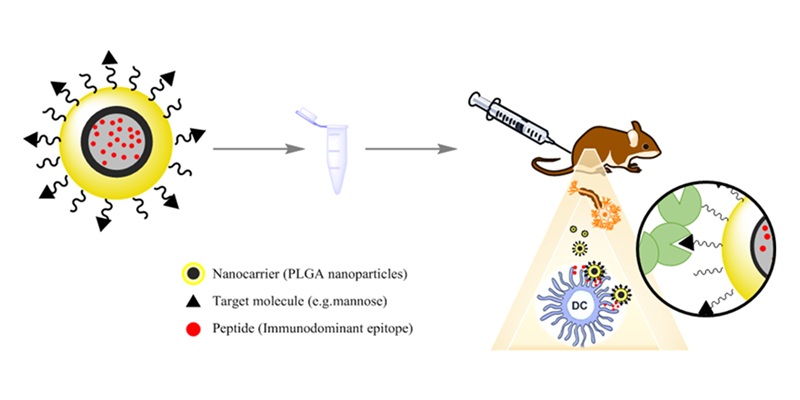
PLGA nanoparticles (NPs) will be developed with the incorporation of immunodominant peptides, epitopes of myelin proteins. The nanoparticles will be surface-modified to target the mannose receptors (MR) of dendritic cells (DCs, important antigen-presenting cells involved in MS). The synthesized compounds will be evaluated using the experimental model of Experimental Autoimmune Encephalomyelitis (EAE, the best-known animal model of MS). The proposed approach targets the mannose receptors on DCs using modified nanoparticles with immunodominant myelin epitopes, in order to achieve tolerance against the disease.
The main objectives of the proposal are:
1.
The design of immunodominant molecules based on myelin protein epitopes and the development of methodologies for their synthesis and encapsulation in nanoparticles with surface modification to target specific receptors.
2.
The characterization of synthesized nanoparticles and the quantification release studies of the encapsulated peptides in aqueous solution and / or blood plasma.
3.
The in vivo/in vitro evaluation of the synthesized molecules using the Experimental Autoimmune Encephalomyelitis (EAE), the best well-known animal model of Multiple Sclerosis (MS).